CSMA/CD - Carrier Sense Multiple Access with Collision Detection
CSMA/CD or Carrier Sense Multiple Access/Collision Detection is a set of rules or protocols that determine how network devices respond when two devices or system attempt to use the same data channel at the same time, resulting in a collision. Ethernet cables used CSMA/CD to monitor the incoming and outgoing data. If there are no other transmissions at the same time as one then it will be able to complete the transmission successfully. However, if there are two attempts which occur at the same time, then this will result in a collision. The main job of the CSMA/CD is to detect any collisions in the data channel and then resend the data.
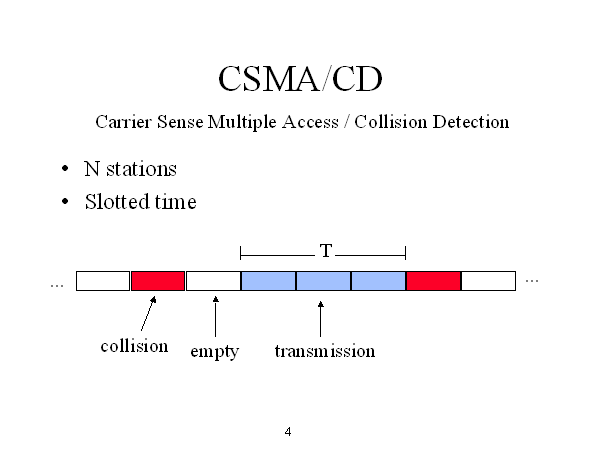 |
| Figure 1. CSMA/CD Process (Courses.cs.washington.edu, 2015) |
In this image (see Figure 1.), it shows how CSMA/CD works and in the data channel, where the collision can occur.
CSMA/CA or Carrier Sense Multiple Access/Collision Avoidance is a network protocol that looks at the network in order to sense and avoid a collision. The difference between CSMA/CA and CSMA/CD is that CD detects the collision but only deals with it once the collision has been confronted, while CA tries to avoid the collision before contact.
Once CSMA/CA has detected the collision it tells the other connected devices not to broadcast data until the collision has been completely avoided.
In the flowchart above (see Figure 2.) it shows the process of how CSMA/CA (collision avoidance) works.
Once CSMA/CA has detected the collision it tells the other connected devices not to broadcast data until the collision has been completely avoided.
 |
| Figure 2. CSMA/CA Flowchart Diagram (Networking-forum.com, 2015) |
Token Passing
In CSMA/CD and CSMA/CA there is always a possibility that a collision could occur. As the number of hosts in the network increase the possibility of collisions will also increase. In token passing, when a host wants to transmit data it should be able to hold the token, which is an empty packet. The token is circling the network at high-speed and if any nodes are wanting to transmit data, it should then wait for the token. When the token has reached the node, the node is then able to take the token from the network, fill it with data, mark the token as being used and then place it back into the network.
Token passing is often associated with circling around the ring topology network. As pictured below (see Figure 3.).

SkyNet-SH
As always thank you for reading today's post, I hope you have managed to learn about some of the access methods that have been basically explained in this post. Next time I will be talking about 'communication models and protocols', so stay updated for that...
Alhamdulillah great 😘 thanks
ReplyDeleteWell explained